ClarixAI
A wrong multiple-choice answer tells you nothing about the reasoning behind it. We built a diagnostic radar that reads open-ended answers and shows teachers which misconceptions are driving the classroom.
- Year
- 2026
- Discipline
- AI · Web · Custom software
- 3
- Languages: NL, EN, HU
- 8
- Misconception meta-tags
- 4-ckpt
- Ensemble: NL production
- HDBSCAN
- Cross-question clustering
About the project
ClarixAI processes open-ended student answers in Dutch, English, and Hungarian through a per-language transformer ensemble (RobBERT-2023, RoBERTa-base, huBERT) with a 1-vs-rest sigmoid head spanning eight misconception meta-tags. HDBSCAN clustering over encoder embeddings surfaces structural patterns across questions, while the dashboard translates each tag into a 'what it means / why it happens / what to do' card. The studio delivered the training pipeline, the inference service, and the teacher dashboard.
ClarixAI analyses open-ended student answers in Dutch, English, and Hungarian to surface the misconception patterns dominating a class (concept confusion, surface-pattern matching, missing preconditions, and six other categories), pairing each with a concrete pedagogical action card. It never grades individual students; it diagnoses how the class reasons. A per-language multi-task transformer ensemble combined with HDBSCAN clustering identifies structural patterns across questions.
01Challenge
- Multiple-choice tests tell you an answer is wrong, never why
- Open-ended answers take far too long to review manually for class-wide patterns
- When teachers cannot see the underlying pattern, 'more practice' becomes the default response
02What we built
- Multi-task misconception classifier across Dutch, English, and Hungarian
- 8 reasoning-error meta-tags, each paired with a concrete teacher action
- HDBSCAN clustering for cross-question structural patterns
- Cohort-level trend dashboard
- Pedagogy library: what each pattern means, why it happens, and how to respond
→Outcome
- Dominant class-wide reasoning errors become visible per question
- Every error pattern comes with an actionable teaching intervention
- Cross-cohort trends make curriculum gaps immediately obvious
03How it shipped
- 01 · BRIEF
Pin the unit of analysis as the reasoning behind the answer, not the answer itself.
The foundational product decision: the system never grades individual students. Instead, it surfaces the misconceptions running through the class so the teacher knows which concept to revisit, and how to approach it.
- 02 · BUILD
Per-language transformers, anti-overfit training recipe, and production ensemble.
We trained RobBERT-2023 for Dutch, RoBERTa-base for English, and huBERT for Hungarian using our v5.0 anti-overfit recipe (frozen lower layers, focal loss, SupCon, and weighted gold data). The Dutch production model ships as a 4-checkpoint ensemble (v6.2) with bounded per-tag thresholds and a k-NN prototype blend, while the English model matches Dutch on gold F1 and outperforms it on adversarial argmax.
- 03 · SHIP
FastAPI inference and Vite/React dashboard live across three languages.
The inference service clusters per-question answers via HDBSCAN over encoder embeddings, surfaces structural cross-question patterns and cohort trends, and feeds the pedagogical knowledge base that turns every tag into an actionable teacher card.
04Result · what shipped
- 01 · Model
Per-language ensemble: 8 misconception tags
RobBERT, RoBERTa, and huBERT with a 1-vs-rest sigmoid head, covering concept confusion, surface-pattern matching, missing preconditions, and five more categories.
- 02 · Pipeline
Classify → cluster → trend
Classifies each answer, runs HDBSCAN clustering over encoder embeddings per question, and rolls up cross-question and cohort-level patterns.
- 03 · Dashboard
Per-question breakdown and cohort trends
A trilingual (NL / HU / EN) Vite and React interface where teachers see misconception density per question right alongside longitudinal cohort trends.
- 04 · Pedagogy
Action card for every misconception tag
Every tag links to a 'what it means / why it happens / what to do' card: the radar surfaces the pattern, and the card guides the teacher's next move.
05Tech
- Python
- PyTorch
- Transformers
- FastAPI
- React
06Screens
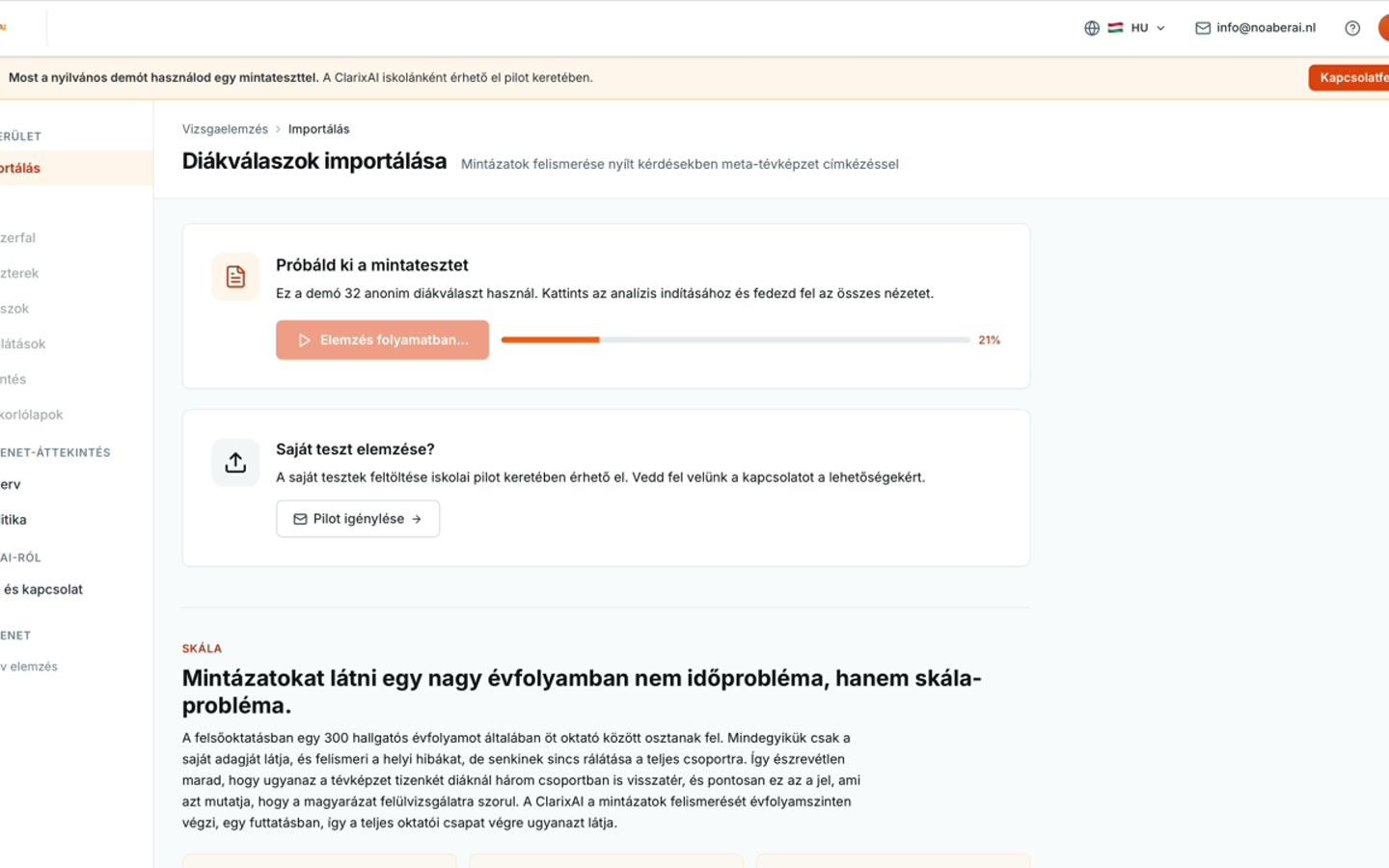
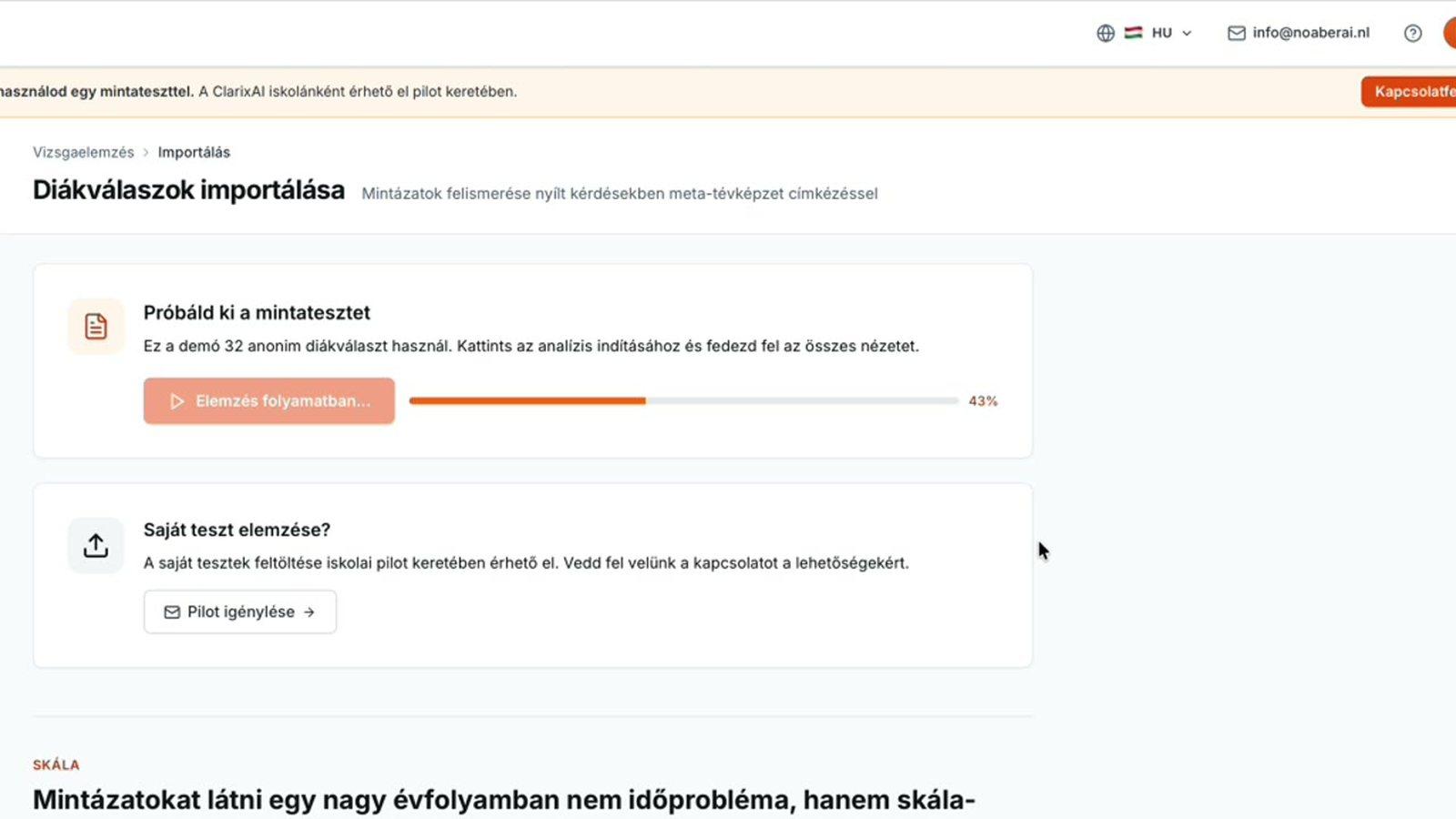
Teachers see at a glance which misconception meta-tags dominate the cohort for each question, focusing on the underlying reasoning pattern rather than who got it wrong.
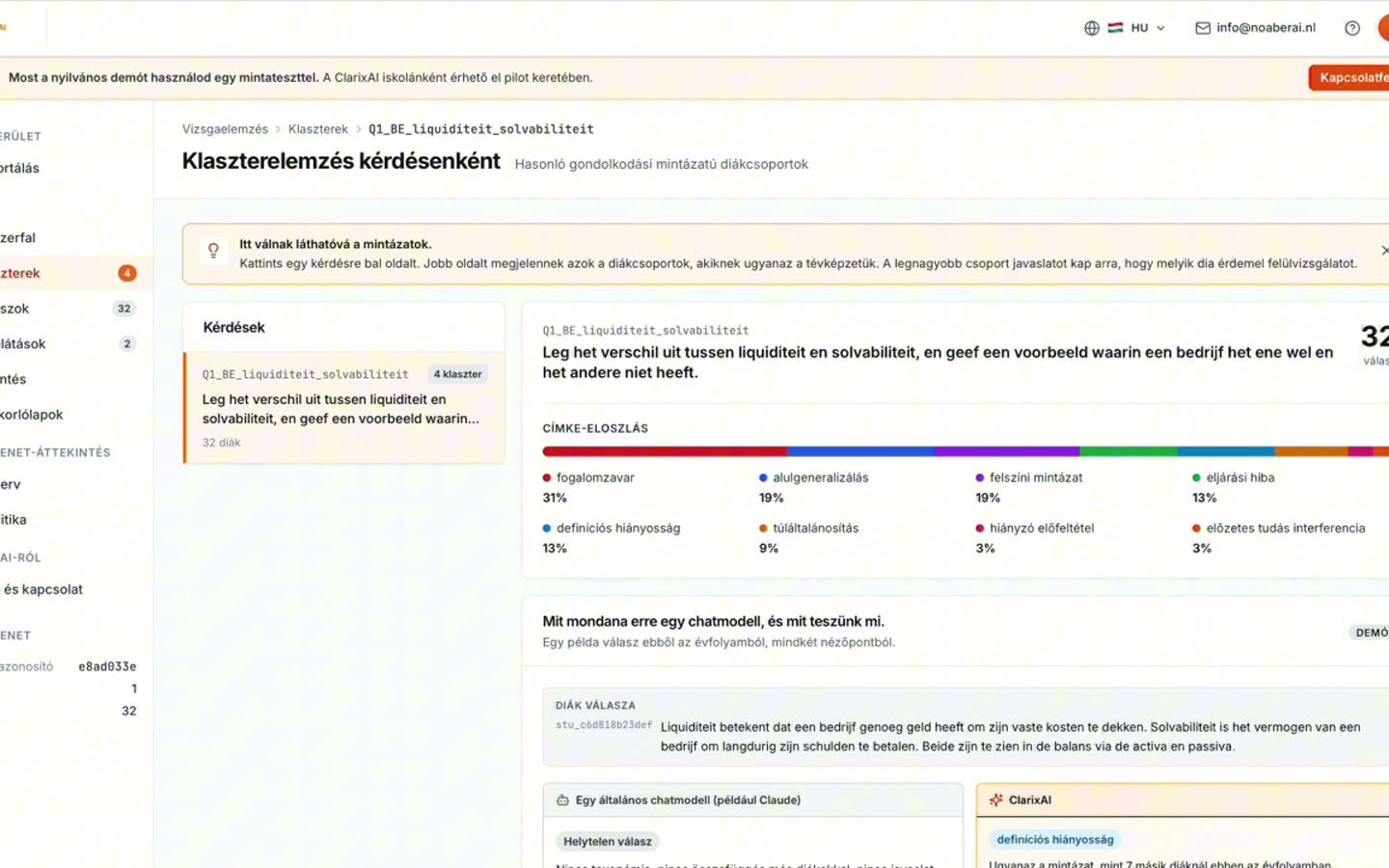
Bounded per-tag thresholds keep the radar honest: a noisy answer won't light up every tag, ensuring the truly dominant misconception stands out.
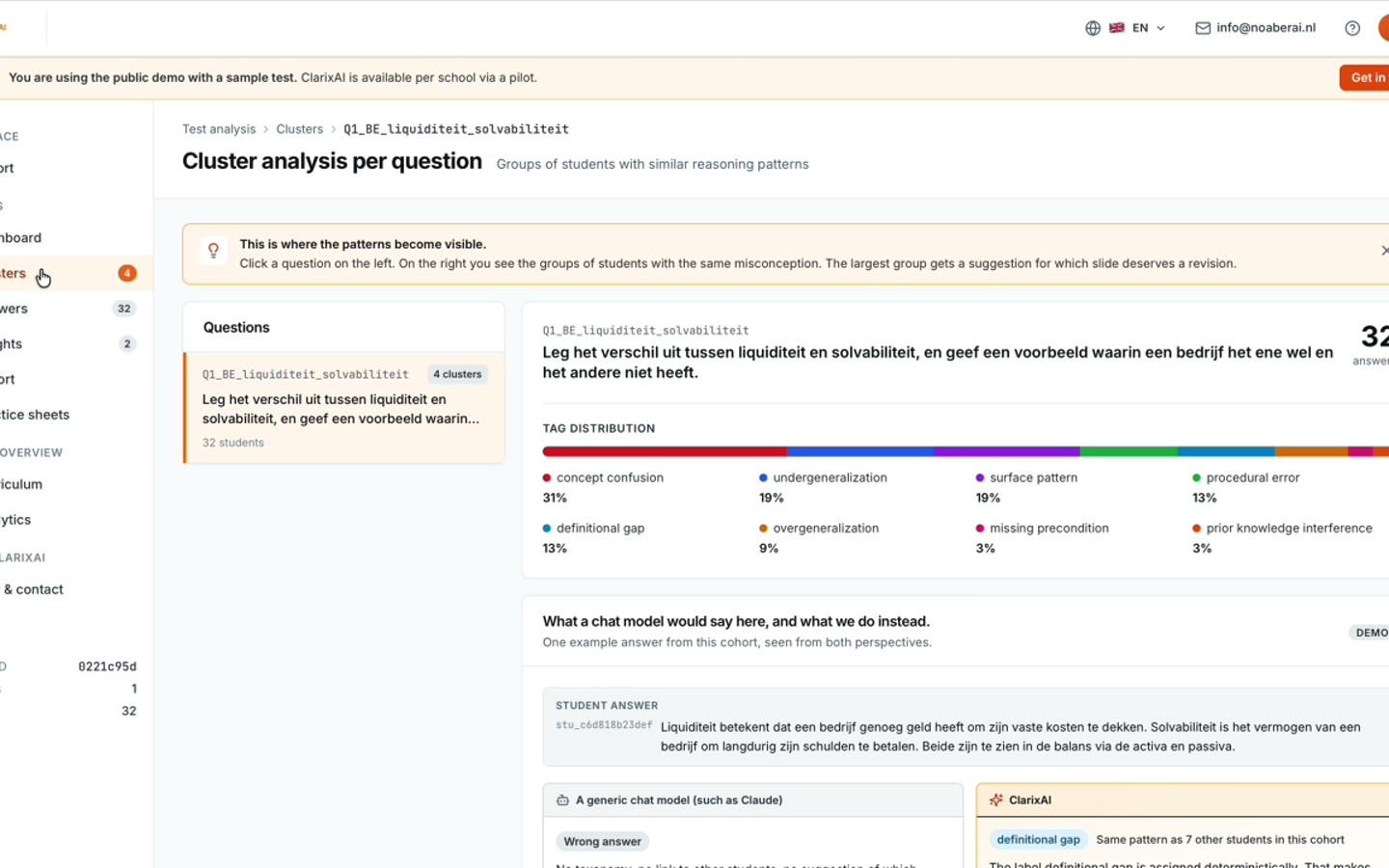
HDBSCAN over encoder embeddings uncovers misconceptions that keep reappearing across different questions, capturing the curriculum-level signal a single-question view misses.
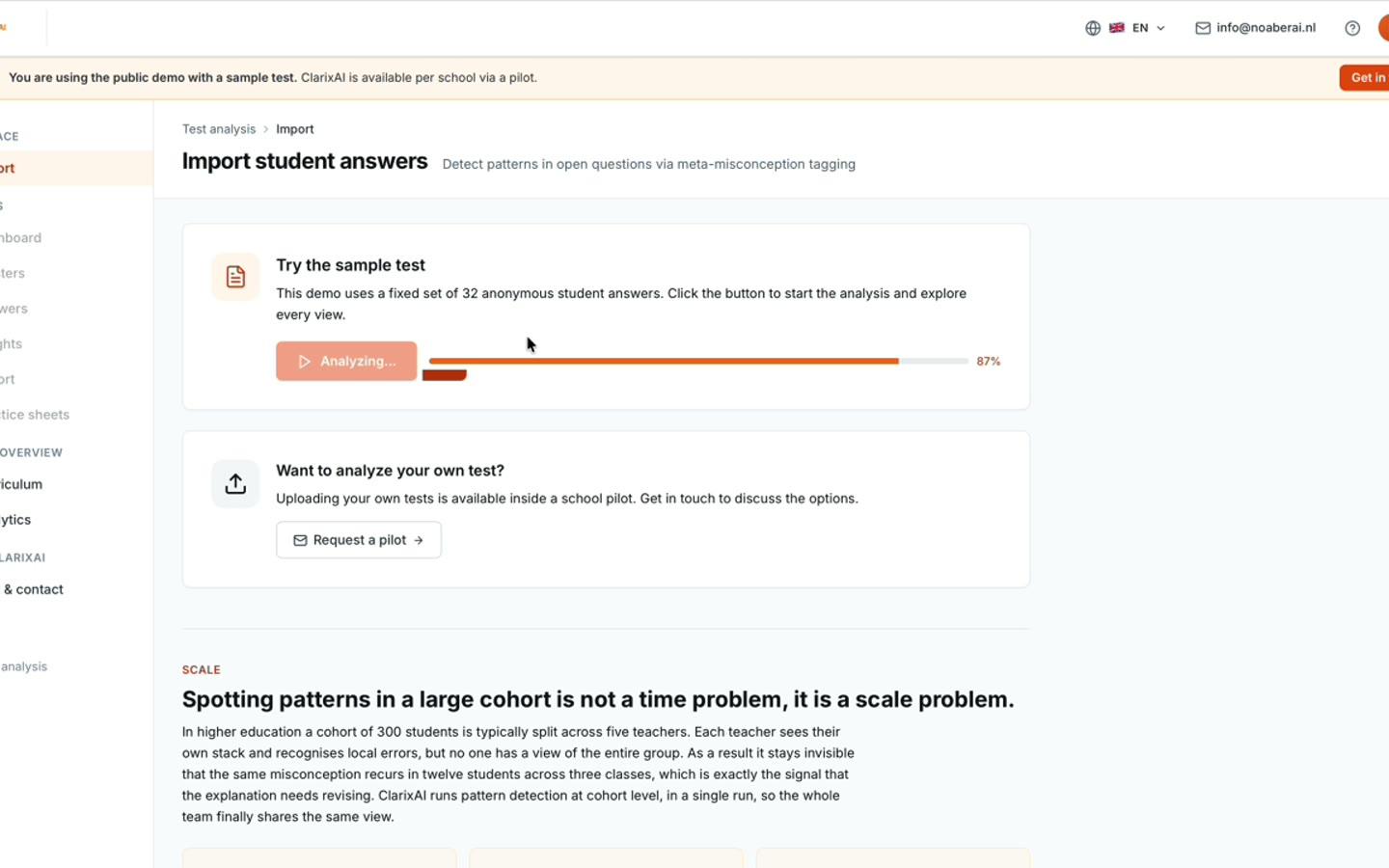
Longitudinal trends across cohorts make curriculum gaps unmistakable: if the same misconception dominates three classes in a row, the lesson material needs adjusting, not just extra practice.
Some of this work was delivered under our former name, DField Solutions (we transitioned to Alkotia because DField Solutions became a standalone product of ours).
Building something similar?
Let's talk→