AIHealthIQ
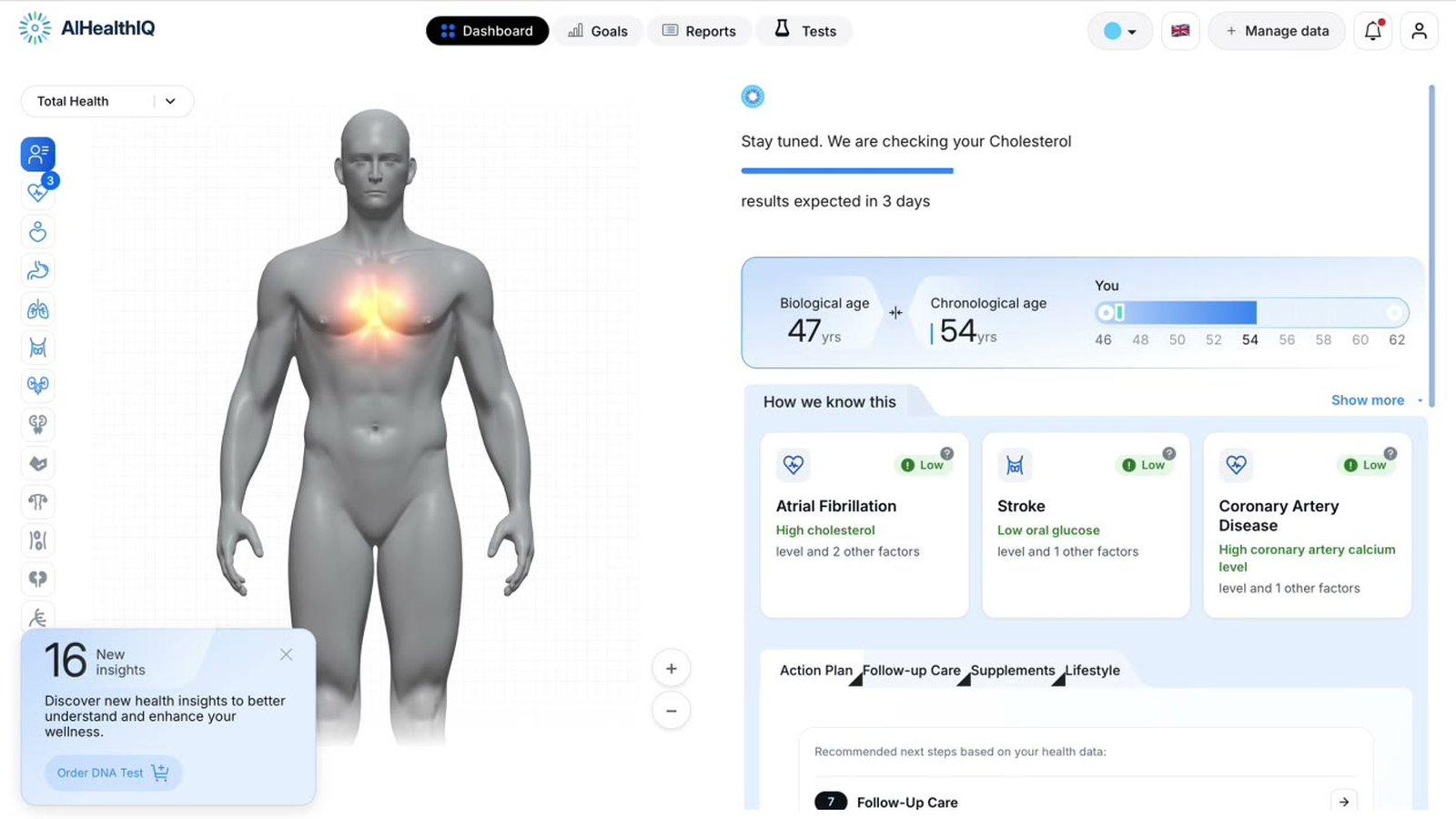
Your smartwatch sees patterns in your sleep, heart rate, and activity that nobody else notices. We built an AI application that interprets your watch data and tells you in plain, everyday language when something shifts.
- Year
- 2026
- Discipline
- AI · Web · Mobile
- 4
- Wearable signal streams
- 3
- Surfaces shipped
- 1
- Correlation pipeline
- API
- Clinical integration API
About the project
AIHealthIQ ingests heart-rate, sleep, step, and blood-oxygen streams from smartwatches and fitness bands, correlates longitudinal trends through an LLM pipeline, and delivers targeted treatment, supplement, and lifestyle recommendations across web and mobile. The studio shipped the data ingestion layer, the correlation pipeline, the recommendation engine, and the user dashboards.
Pulls data from smartwatches, fitness bands, and connected sensors (heart rate, sleep, steps, blood oxygen), correlates trends with AI, and delivers actionable recommendations across treatment, supplementation, and lifestyle. Available on web, mobile, and via API.
01Challenge
- Smartwatches collect mountains of data that nobody interprets in context
- Everyday biometric trends rarely make it into a doctor's office
- Users struggle to tell when a change actually warrants booking a consultation
02What we built
- Wearable data ingestion across major devices
- AI correlation analysis and longitudinal trend tracking
- Actionable treatment and lifestyle recommendations
- Unified web and mobile UI, backed by a clinical API
→Outcome
- Continuous, automated monitoring over your personal health signals
- AI flags meaningful shifts rather than day-to-day noise
- Concrete lifestyle interventions instead of generic advice
03How it shipped
- 01 · BRIEF
Map the wearable signals that actually carry diagnostic weight.
We ran a workshop with the founders to isolate the four signals (heart rate, sleep, steps, SpO2) that meaningfully drive recommendations, dropping everything else from the v1 scope.
- 02 · BUILD
Express ingestion, LLM correlation, and a shared Redux state layer.
An Express backend ingests vendor-specific wearable feeds, normalises them into SQLite, and uses OpenRouter to route each signal type to the best-suited model. A shared Redux store shape drives both the React web app and the mobile client.
- 03 · SHIP
Web, iOS, and Android apps shipped alongside a public clinical API.
Three end-user surfaces launched on top of the same correlation engine, accompanied by a HealthApplication-typed, JSON-LD-annotated API for clinical integrations.
04Result · what shipped
- 01 · Ingestion
Per-vendor wearable feeds normalised
Apple Health, Garmin, Fitbit, and Oura streams normalised into a single internal schema prior to correlation.
- 02 · AI engine
OpenRouter-routed correlation engine
Different signal combinations route to the model best equipped to interpret them, with cost-aware fallbacks on every request.
- 03 · UI
Web, iOS, and Android driven by a single store
A shared Redux store architecture across React web and React Native mobile provides a single source of truth for every trend card.
- 04 · API
Clinic-grade JSON API
HealthApplication-typed schema allowing partner clinics to pull structured patient summaries on demand.
05Tech
- Express
- React-Redux
- SQLite
- OpenRouter
06Screens
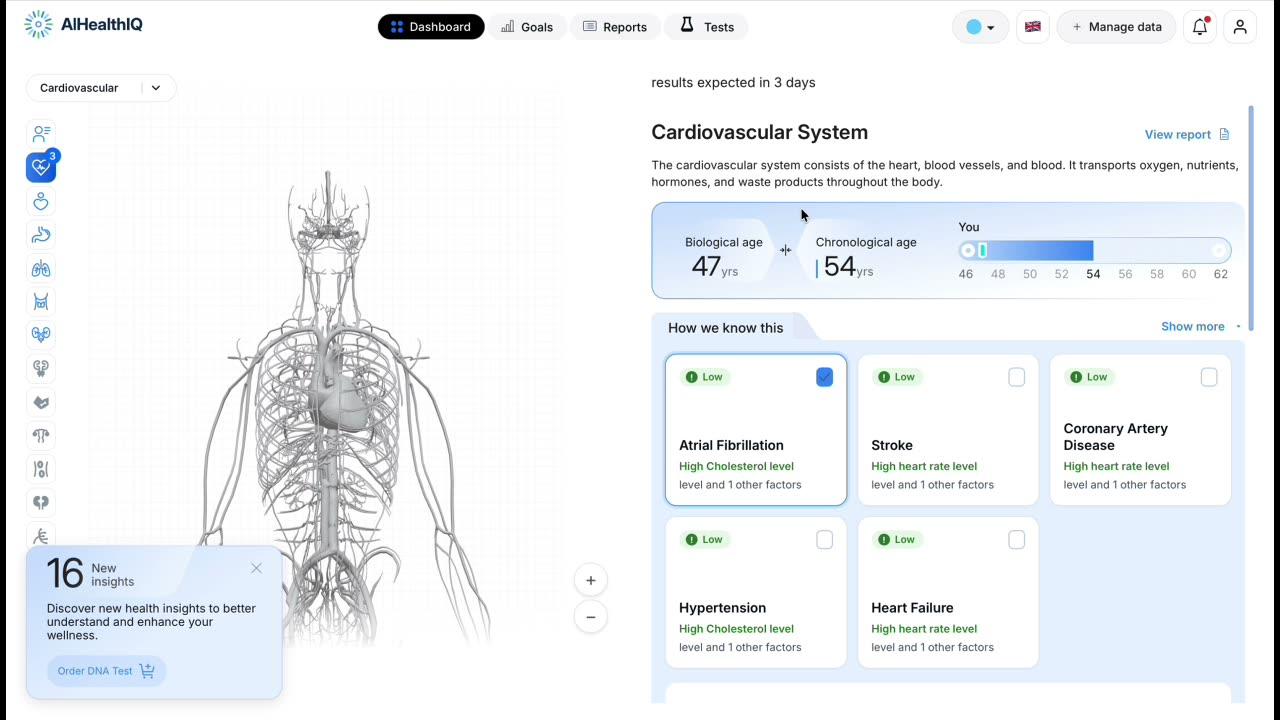
Anatomical view pairing biological age (47) against chronological age (54) alongside six stratified risk cards (atrial fibrillation, stroke, coronary artery disease, hypertension, heart failure).
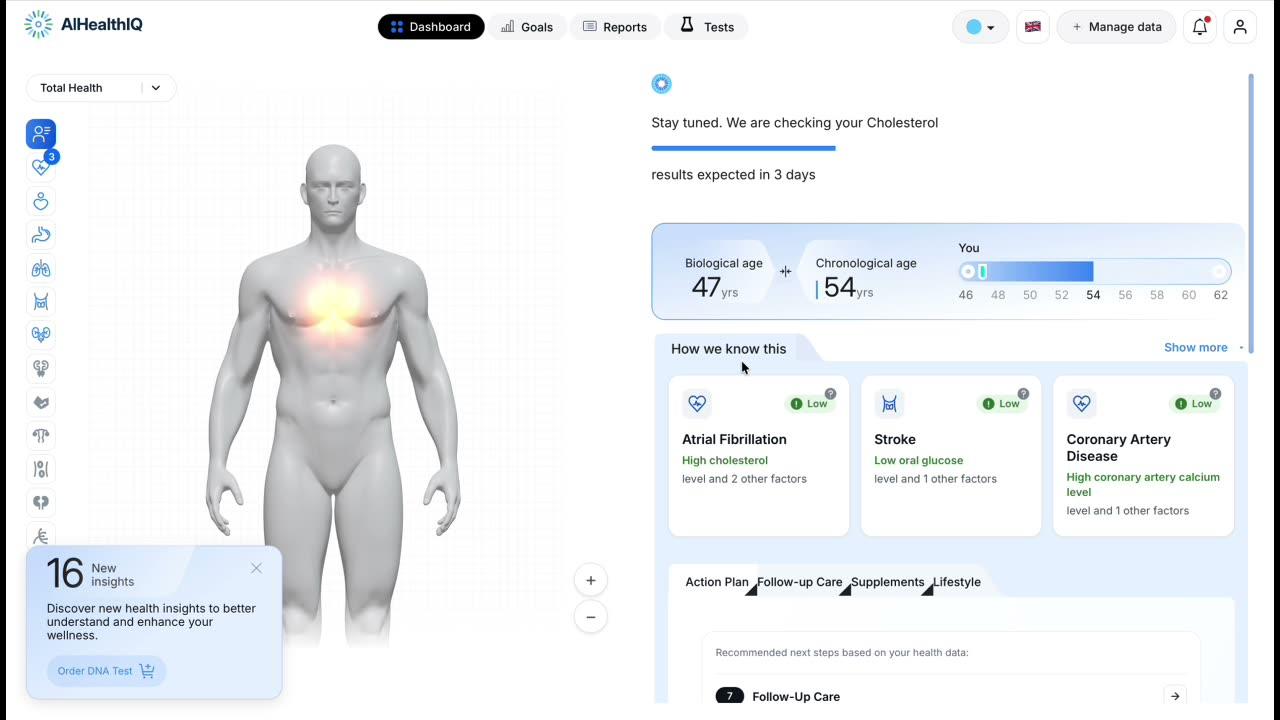
As the cholesterol analysis runs, the heart highlight pulses, showing the user in real time which organ system the AI is evaluating.
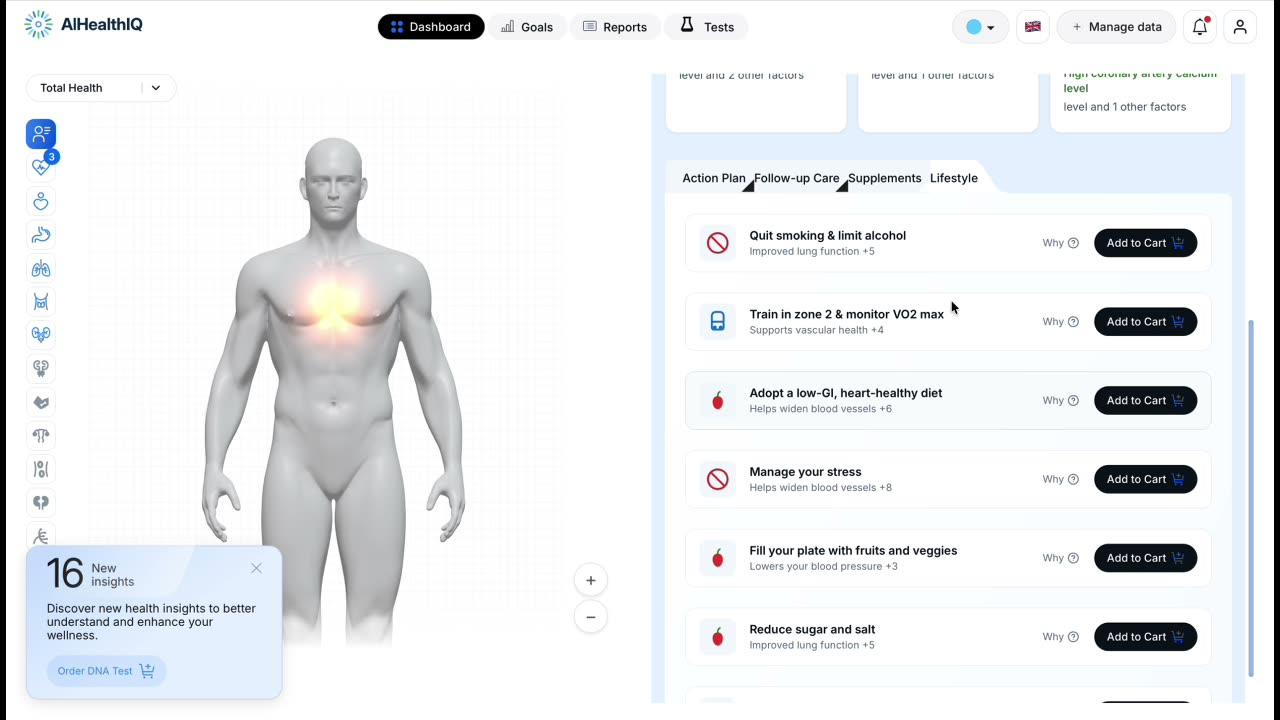
Quit smoking, Zone 2 cardio, low-GI nutrition, stress management, produce intake, and sugar reduction: each prescription card pairs clinical rationale with a direct 'Add to cart' link for the relevant supplement or device.
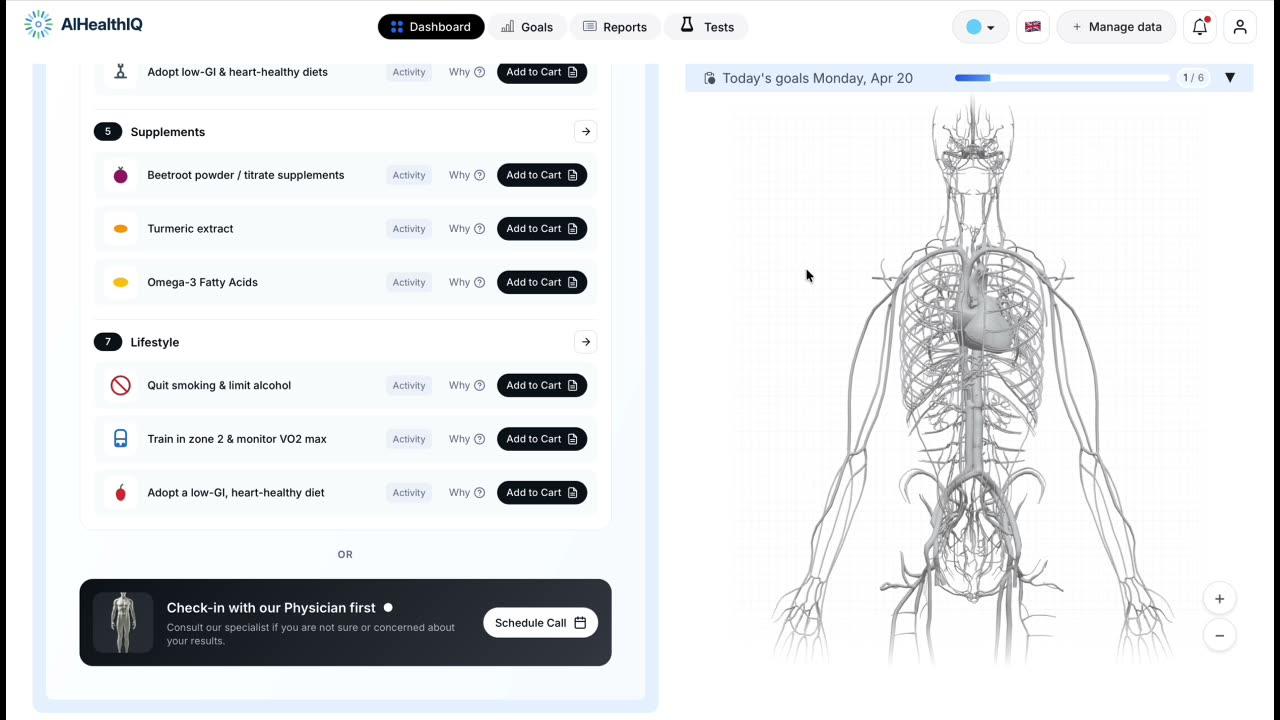
Beetroot, turmeric, and omega-3 appear under targeted supplements, followed by daily lifestyle protocols, anchored by a 'Check-in with our Physician first' CTA whenever the user wants a clinician in the loop.
Some of this work was delivered under our former name, DField Solutions (we transitioned to Alkotia because DField Solutions became a standalone product of ours).
Building something similar?
Let's talk→